Douglas Ryan Favero
Ways of reading · Cormac McCarthy

No Country for Old Men

Eight questions about the book, four about the whole of it and four about single chapters. Each one is answeredfour ways, through a literary theory or an idea from philosophy, sociology, psychology or religion.

The answers don’t always agree. Some theories open a question up and some have little to say about it, and each answer says which. Swipe or use the arrows to move between them.

Map of every place in the book

Follow one theory through the book
Literary theory
Gender and sexuality
Society and economics
Philosophy
Psychology
Religion
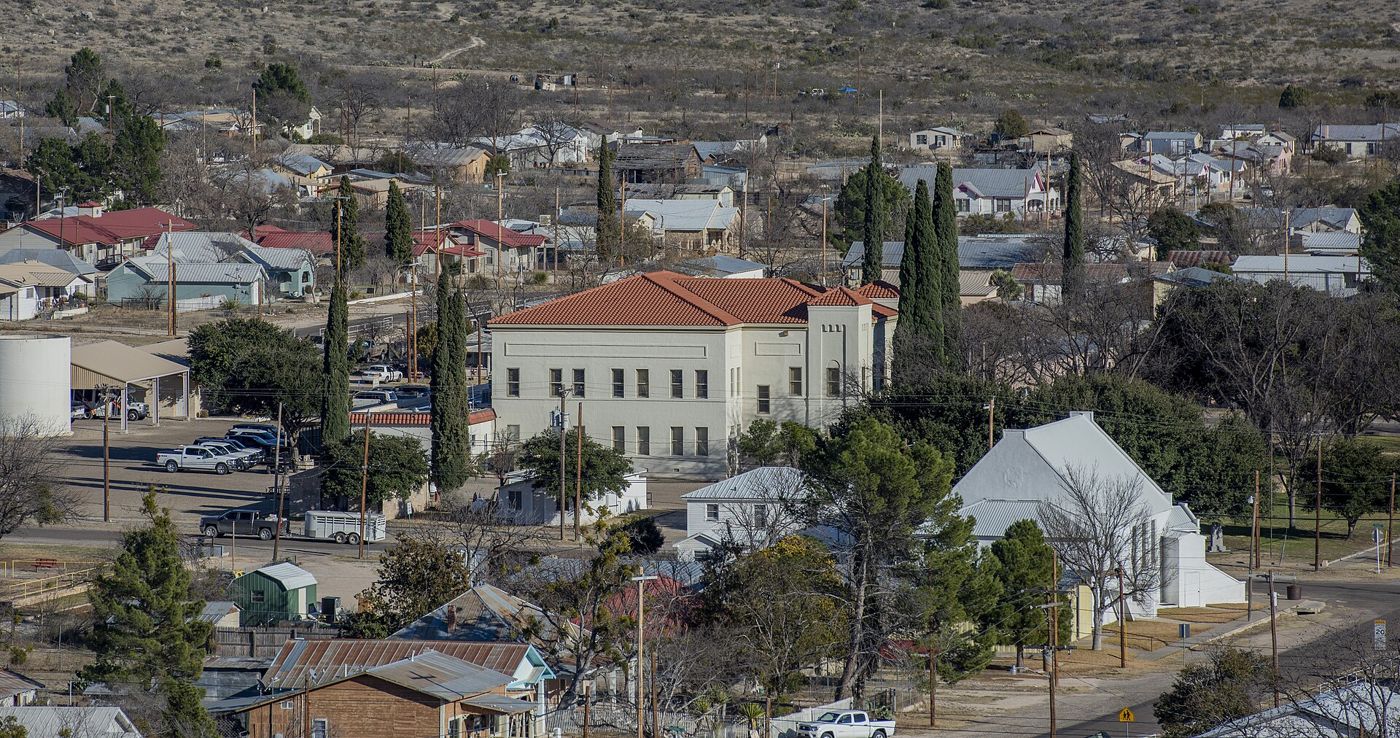
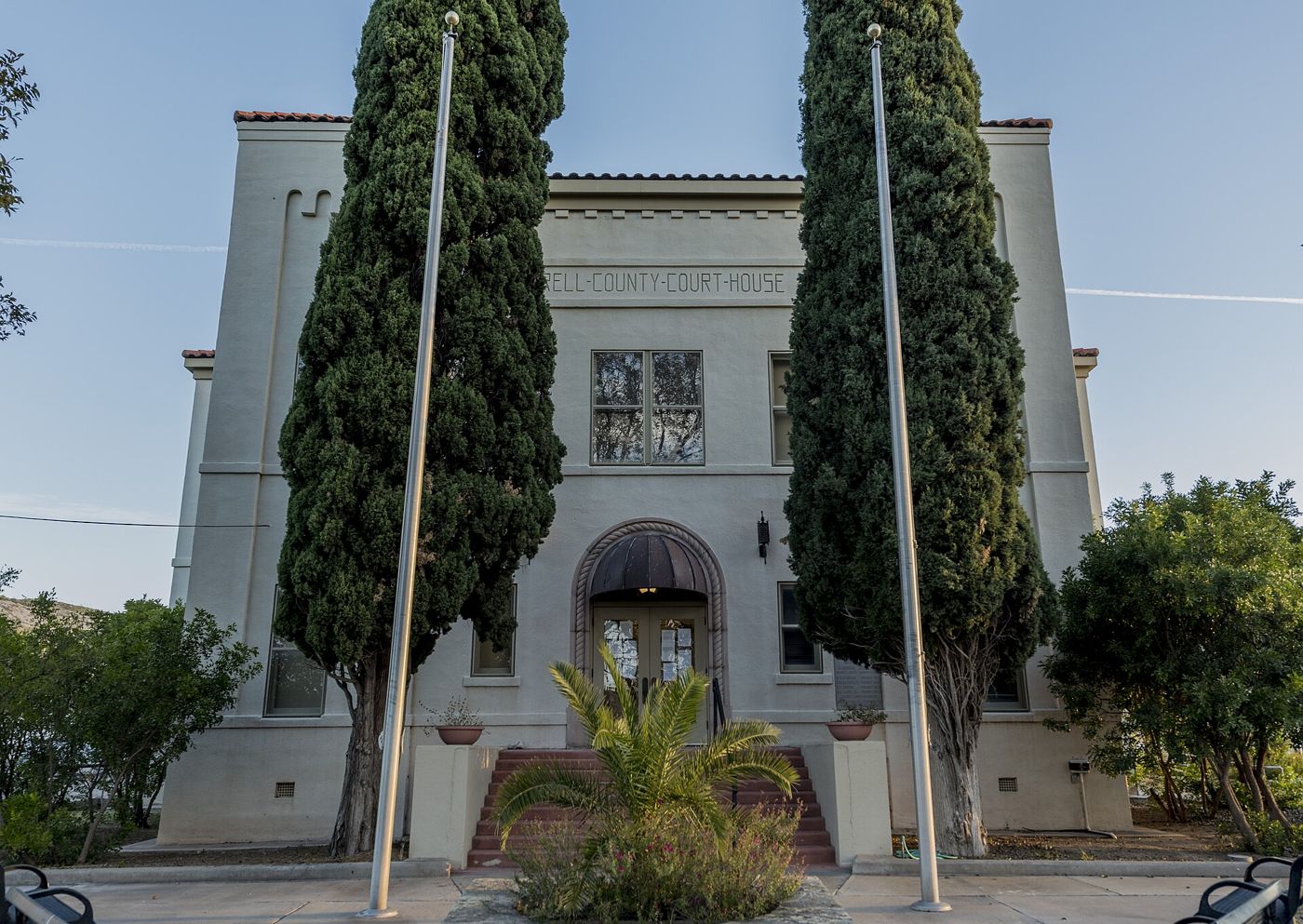
The Terrell County Courthouse in Sanderson, Texas
1 · The whole book · Bell’s monologues

Why is the book named for the old sheriff?

Aualliso, CC BY-SA 4.0

The title comes from the first line of Yeats’s “Sailing to Byzantium” (1928): “That is no country for old men.” The old man is Sheriff Ed Tom Bell, who opens each of the thirteen chapters talking to us in italics. But Llewelyn Moss and Anton Chigurh drive the story, and Bell never catches up with either of them.

New Criticism

What do the words on the page do, apart from the author’s life?

Look at how the book is built. Every chapter starts with Bell’s voice, plain and in his own grammar, looking back from after it is all over. Then the action cuts in, fast and in the present. The frame tells you how to take the plot before you’ve read it: as something remembered by a man it defeated.

The two parts keep rubbing against each other. The action is all hands, guns, motels and highways. Bell’s pages are about manners, his wife, his father and the war. The thriller is what happened. The monologues are what it meant to him, and the title belongs to them.

Opens a lot here

Where it falls short. It shows the shape clearly but can’t say whether Bell is right about the world.

Cleanth Brooks, The Well Wrought Urn (1947)
Genre theory

What rules does the genre set up, and what happens when the book breaks them?

John Cawelti described popular genres as formulas, with rules readers expect to see kept. The western and the crime novel share one: the lawman tracks the killer, and they meet. McCarthy sets the formula up and refuses it. Moss, the man we have followed for most of the book, dies offstage, and we only see what is left. Bell arrives after.

Bell refuses the showdown in so many words: “I wont push my chips forward and stand up and go out to meet him.” The book is named for the one character who steps out of the formula, which makes it a book about the formula.

Opens a lot here

Where it falls short. It explains the shock of the structure better than the feeling the book leaves.

John G. Cawelti, Adventure, Mystery, and Romance (1976)

Generations

What makes people born around the same time into a generation?

Karl Mannheim argued that a generation is made by a shared event. Bell belongs to the Second World War. Moss and Carson Wells, as they tell each other in the hospital, were both in Vietnam. The old man can’t read the younger men, and the book sets his war beside theirs.

Bell himself says, of his family’s history in Texas, “Two generations in this country is a long time.” The title’s “old men” are a generation as much as a single sheriff.

Some light

Where it falls short. Chigurh has no generation and no history at all, and the theory has nothing to say about him.

Karl Mannheim, “The Problem of Generations” (1928)

Reader-response

What does the reader bring, and what does the text leave for the reader to fill in?

Hans Robert Jauss wrote about the “horizon of expectations” a reader brings to a book. Readers of a chase novel expect a climax, and when Moss dies offstage many feel cheated. That frustration is part of the design: the reader is put where Bell is, arriving too late and wanting things to make sense.

Some light

Where it falls short. It explains the frustration but not why the book still moves readers once they get past it.

Hans Robert Jauss, “Literary History as a Challenge to Literary Theory” (1967)

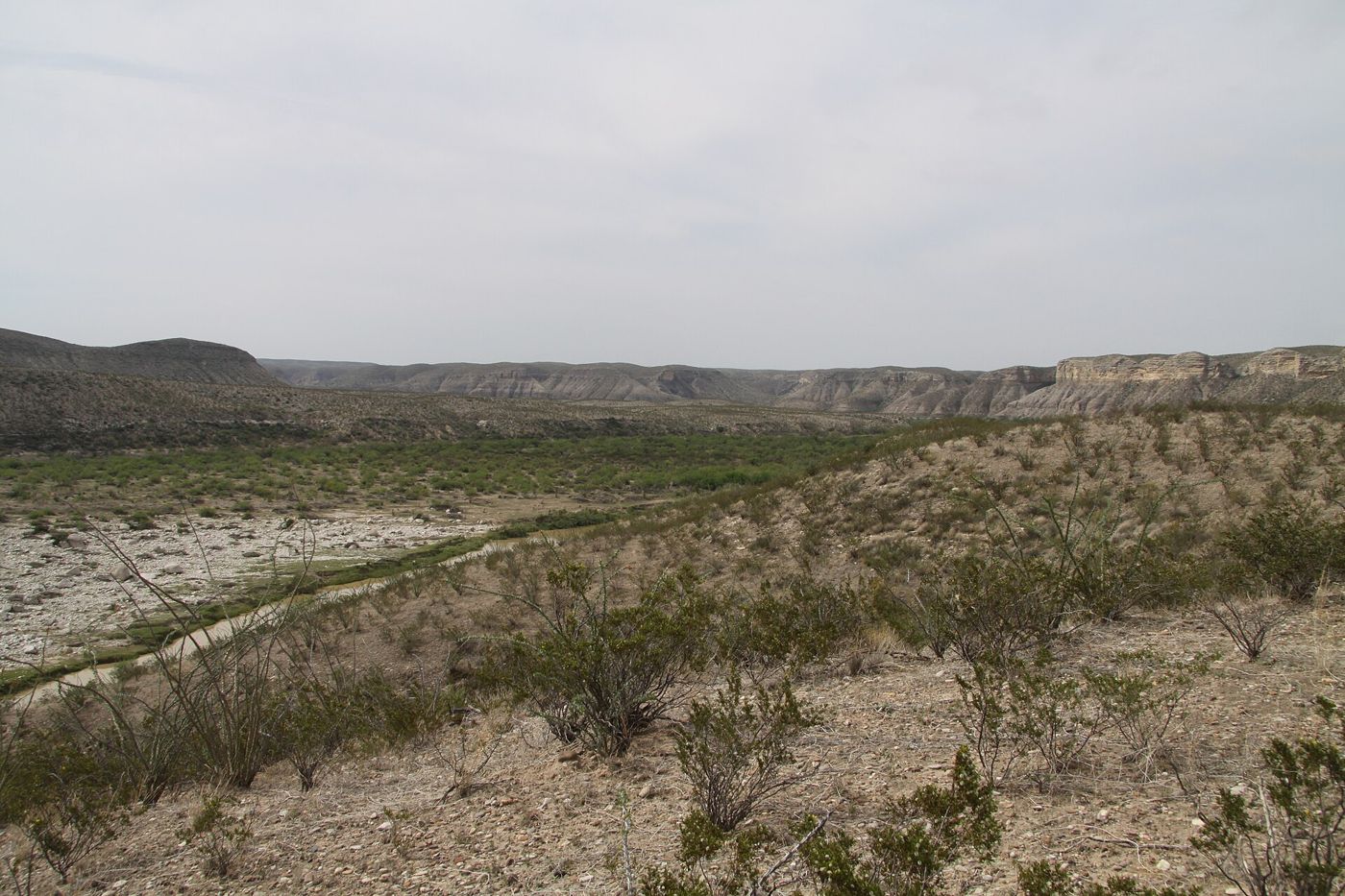
The Rio Grande at the mouth of Lozier Canyon
2 · The whole book · Anton Chigurh

What is Chigurh?

NPS photo, Public domain

Chigurh kills with a captive bolt pistol, one of those “stunguns like they use at the slaughterhouse,” as the deputy who arrests him puts it. He keeps his word, lets a coin decide, and has no past in the book. Bell calls him “a true and living prophet of destruction.”

Christian reading

What does the story share with scripture and Christian practice?

Bell reaches for scripture to describe him: a “prophet of destruction.” Elsewhere he says that if you were Satan trying to bring the human race to its knees, what you would come up with “is narcotics.” Chigurh moves through the book like a figure from Revelation more than a man, appearing, killing and walking away with his wounds.

He even speaks the language of providence. “For things at a common destination there is a common path,” he tells Carla Jean. He talks like predestination with a shotgun.

Opens a lot here

Where it falls short. It makes him a symbol, which lets the reader off from seeing him as a man who chooses.

Revelation 6:8

Kantian aesthetics

Can beauty be enjoyed without wanting anything from it?

Kant’s moral law asks you to act only on a rule you could will everyone to follow, without exceptions for yourself. Chigurh is a dark parody of this. He keeps his word without exception. He promised Moss he would kill Carla Jean, and when she asks why, he says, “I gave my word.”

He also asks Wells, “If the rule you followed led you to this of what use was the rule?” But Kant had a second rule: treat people always as ends, never only as means. Chigurh keeps the form of morality and throws out the person, which is what makes him so frightening.

Opens a lot here

Where it falls short. Kant can describe the logic but not the violence. Nothing in the theory explains why this particular rule.

Immanuel Kant, Groundwork of the Metaphysics of Morals (1785)

Marxist criticism

Who pays, who works, and how does the text hide it?

Strip away the mythology and Chigurh is an employee. He works for money men, collects their property, and at the end returns most of it to an office to “establish my bonafides” as someone “completely reliable and completely honest.” He talks about the “new people” who will run things now.

Read this way, he is the drug economy’s ideal worker: no loyalties but the contract, no feelings that get in the way of the job.

Some light

Where it falls short. It explains whom he works for, not the coin or the philosophy he lives by.

Fredric Jameson, Postmodernism, or, The Cultural Logic of Late Capitalism (1991)

Psychoanalytic criticism

What does the text do with a wish or a loss it can’t face directly?

Psychoanalytic criticism needs a history: a childhood, a wish, a wound. Chigurh has none. We never learn where he comes from, what he wants for himself, or what he fears. The book gives a Freudian reader nothing to interpret but his behavior.

That emptiness is the point. He is written to resist exactly this kind of explanation, so the theory fails in a way that tells you something about the character.

Little to work with

Where it falls short. Nothing to work with. The text refuses it on purpose.

Peter Brooks, Psychoanalysis and Storytelling (1994)

The Terrell County Courthouse in Sanderson, Texas, in winter
3 · The whole book · Chapters VII and IX

Does Bell fail?

Aualliso, CC BY-SA 4.0

Late in the book Bell tells his Uncle Ellis about the war. He was given the Bronze Star after he left his position and the men in it. “And I told him I didnt want it.” Before that he has already said he won’t go out to face Chigurh. At the end he retires.

Christian existentialism

Drawn from Douglas Ryan Favero’s essay in The Cormac McCarthy Journal 19.2.

How do people find the courage to exist in the face of death, meaninglessness and guilt?

Paul Tillich described three anxieties that threaten a person: of fate and death, of emptiness and meaninglessness, and of guilt and condemnation. Earlier readings of the novel looked at the first two. Favero’s essay argues that the third, the anxiety of self-condemnation, is what drives Bell.

Since he left his men in France, Bell has lived by a rule: “I thought if I lived my life in the strictest way I knew how then I would not ever again have a thing that would eat on me thataway.” The rule protects him from judging himself, and it also keeps him from putting himself at risk for the people in his care. He tells Uncle Ellis that God has a low opinion of him. Ellis answers, “You dont know what he thinks.”

For Tillich, courage is accepting that you are accepted in spite of being unacceptable. Read this way, Bell’s retirement isn’t cowardice. He is letting go of a false promise, and by the last pages he is beginning to accept his wife’s love and, in the dream of the fire, his father’s.

Opens a lot here

Where it falls short. It gives the fullest account of Bell, but it reads the book through a Christian theology the novel mostly leaves unspoken.

Paul Tillich, The Courage to Be (1952); Douglas Ryan Favero, “‘You don’t have to do this’: Cormac McCarthy’s No Country for Old Men and the Courage to Be,” The Cormac McCarthy Journal 19.2 (2021)

Masculinity studies

How do men measure themselves against a model of manhood?

Bell measures himself against the old lawmen: his grandfather, Uncle Mac, sheriffs he heard stories about who never carried a gun. That is the western ideal of manhood, and he thinks he falls short of it.

The novel tests the ideal. Uncle Ellis tells him the legend about Uncle Mac is “all bull”: he was “shot down on his own porch in Hudspeth County.” The old manhood Bell grieves may never have existed as he imagined it.

Opens a lot here

Where it falls short. It can make Bell’s retirement look like a lesson about gender, when he describes it as a moral failure.

R. W. Connell, Masculinities (1995)

Recognition theory

What happens when people need to be seen and valued and aren’t?

Axel Honneth argues that people need recognition that matches what they actually did. Bell’s life is built on recognition he thinks he didn’t earn: the Bronze Star, the county that keeps electing him, a wife who thinks well of him.

He tries to refuse the medal, and the major orders him to accept it. Recognition he hasn’t earned works on him like an accusation, and it keeps him from accepting the praise he has earned since.

Opens a lot here

Where it falls short. It explains the war story well, less so the plain fact that one sheriff couldn’t have stopped Chigurh.

Axel Honneth, The Struggle for Recognition (1992)

Existentialism

Where does a person deny his own freedom so he won’t have to answer for it?

For Sartre, blaming the times is a familiar form of bad faith. Bell spends whole monologues on signs of the times: drugs, bad manners, children raised by grandparents. In this light, the world getting worse is a story that lets him off from choosing.

But Bell does choose. He says plainly he won’t go out to meet Chigurh, and he says it in the first person. That makes him harder to convict of bad faith than he first seems.

Some light

Where it falls short. Kevin Stadt reads Bell’s retirement as a fall back into bad faith. Favero’s essay argues the opposite: that Bell is giving up a false role, not hiding in one.

Jean-Paul Sartre, Being and Nothingness (1943); Kevin Edwin Stadt, “Sheriff Bell’s Bad Faith,” British and American Fiction 22.2 (2015)

The international bridge between Eagle Pass and Piedras Negras
4 · The whole book

Is the country getting worse?

Los viajeros 77, CC BY-SA 4.0

Bell thinks so. “It starts when you begin to overlook bad manners. Any time you quit hearin Sir and Mam the end is pretty much in sight.” Uncle Ellis, telling family stories of killings and widows, puts it another way: “This country was hard on people.”

Marxist criticism

Who pays, who works, and how does the text hide it?

Bell’s own word for the decline is economic: “the sort of breakdown in mercantile ethics” that leaves people dead in the desert. The drug trade in the book is a business with offices. In Houston, Wells is hired on the seventeenth floor, looking over the ship channel and the “colonies of silver tanks” of the oil refineries.

A Marxist reading says the country isn’t losing its manners so much as finding its market. The same skyline holds the oil money and the drug money.

Opens a lot here

Where it falls short. It explains the money but not Bell’s sense that something spiritual is going.

Fredric Jameson, Postmodernism, or, The Cultural Logic of Late Capitalism (1991)

Borderlands theory

What does life look like from the border, between two countries?

Gloria Anzaldúa called the U.S.–Mexico border “una herida abierta,” an open wound, where two countries grind against each other. The novel takes place almost entirely on that border, and its Mexico is mostly a source of drugs, gunmen and danger. Moss crosses the bridge at Eagle Pass to a hospital in Piedras Negras, and the Mexican characters who appear mostly kill or die.

A borderlands reading asks whose country the title means. To the families on the other side of the river, the same land has its own long history of violence.

Opens a lot here

Where it falls short. The book barely enters Mexico, so the theory mostly reads what is absent.

Gloria Anzaldúa, Borderlands/La Frontera (1987)

The civilizing process

How do self-control and shame sort people into higher and lower?

Norbert Elias showed that manners are where self-control begins, so Bell is not wrong to start with “Sir and Mam.” In Elias’s terms he is describing a civilizing process running backward.

But Elias also showed that violence was more common in the past, and the novel agrees with him. Ellis’s stories of Uncle Mac and of a widow left with land she couldn’t pay the taxes on show that the old country was no gentler.

Some light

Where it falls short. Elias works on centuries; Bell is talking about a few decades.

Norbert Elias, The Civilizing Process (1939)

Christian reading

What does the story share with scripture and Christian practice?

Ecclesiastes says there is nothing new under the sun, and Ellis’s side of the argument sounds like it. The book keeps returning to whether God is watching. Bell asks Ellis, “Do you think God knows what’s happenin?” and Ellis answers, “I expect he does.”

In this reading the question isn’t whether the country is getting worse, but whether there is any judgment over it at all.

Some light

Where it falls short. It turns a social question into a religious one, which some readers will feel dodges Bell’s complaint.

Ecclesiastes 1

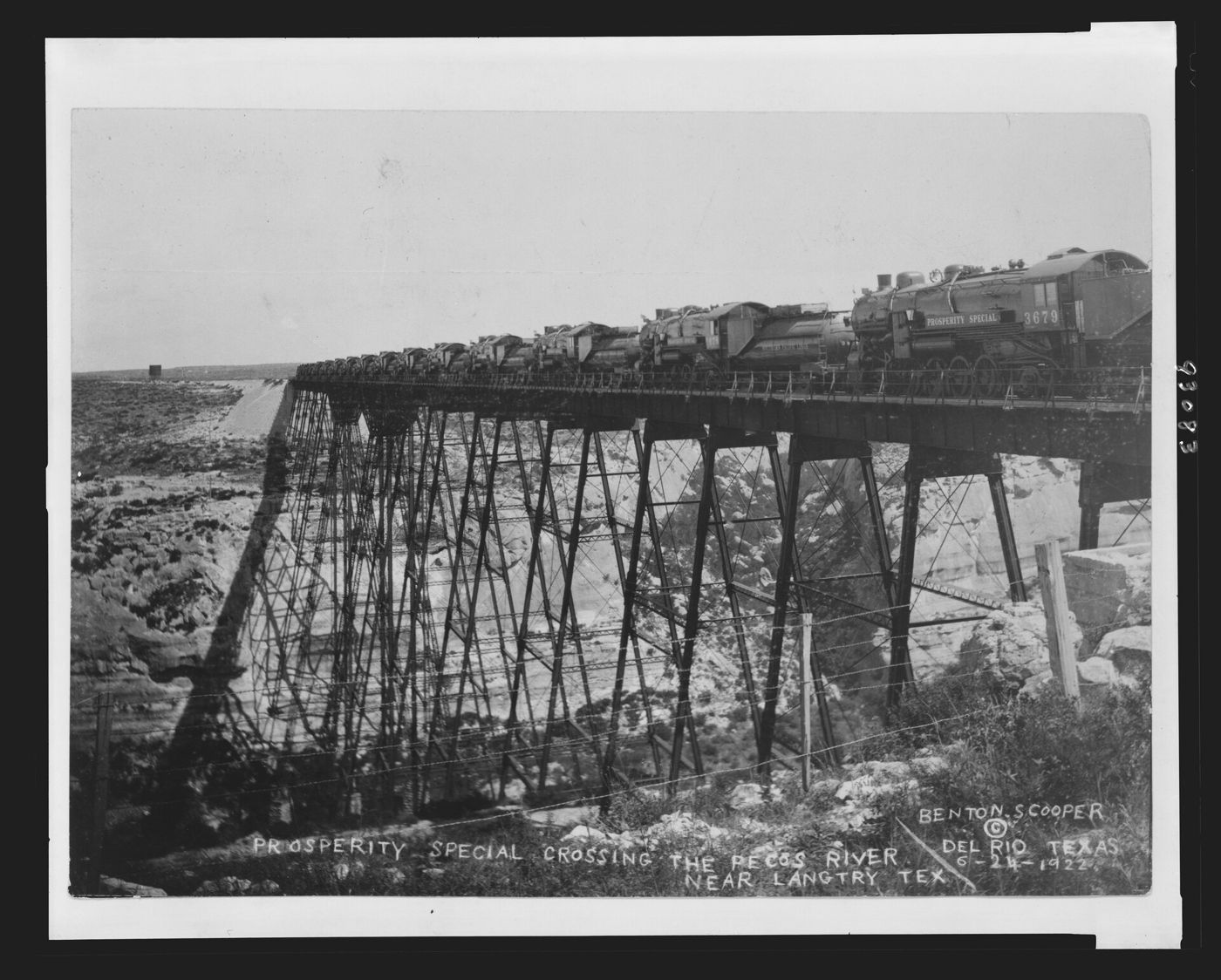
A train crossing the Pecos River High Bridge in 1922
5 · Chapter II · The gas station at Sheffield

What does the coin decide?

Library of Congress, Public domain

Chigurh stops for gas at Sheffield, and the old man behind the counter asks a harmless question. Chigurh flips a quarter and tells him to call it. “It’s been traveling twenty-two years to get here. And now it’s here. And I’m here.” When the man asks what he stands to win, Chigurh tells him: “You stand to win everything.”

The absurd

How do people live when the world gives no meaning back?

Camus defined the absurd as the clash between our need for meaning and a world that gives none. The coin is the absurd made into an object. A man’s life depends on a quarter minted in 1958, and nothing he has done in his life matters to the outcome.

Chigurh says the man has been “putting it up your whole life. You just didnt know it.” That is close to Camus: every life is always at stake, and most people don’t notice.

Opens a lot here

Where it falls short. Camus answered the absurd with revolt and solidarity. Chigurh uses it to kill people, and the theory can’t tell you why.

Albert Camus, The Myth of Sisyphus (1942)

New Criticism

What do the words on the page do, apart from the author’s life?

Read the scene closely and the tension is all in small details. The man keeps asking what they’re calling for. Chigurh won’t tell him. The coin’s twenty-two-year journey turns a dull object into fate. And the setting is ordinary: a country gas station, cashews, the price of fuel.

The man calls heads and wins. Chigurh gives him the coin and tells him not to put it in his pocket, where “you wont know which one it is.” Then he explains: “Anything can be an instrument.” The scene turns a quarter into a symbol and then warns you that any object could be one.

Opens a lot here

Where it falls short. It sees how the scene works but leaves the big question, chance or choice, untouched.

Cleanth Brooks and Robert Penn Warren, Understanding Fiction (1943)

Christian reading

What does the story share with scripture and Christian practice?

Christian thought has long asked whether chance exists or whether everything is providence. Proverbs says the lot is cast into the lap, but every decision is from the Lord. Chigurh borrows this. To him the coin isn’t chance but a path already laid down.

The gas station owner survives, which a reader can take as grace. The book doesn’t say.

Some light

Where it falls short. The scene works whether or not God is in it, so the reading adds a frame more than an insight.

Proverbs 16:33; John Calvin, Institutes of the Christian Religion (1559), book 1

Deconstruction

Where does the text undo what it claims?

Deconstruction looks for where a text’s logic undoes itself. Chigurh claims he is like the coin, an instrument with no say. But he is the one who chose to flip it, chose the stakes, and chose who has to call. Carla Jean says it later: “The coin didnt have no say. It was just you.”

The coin can only mean something because someone decides what calling it means. The scene builds that dependence into Chigurh’s philosophy and then shows it.

Opens a lot here

Where it falls short. It tends to end with “the meaning is unstable,” which is where the book starts, not where it ends.

Jacques Derrida, “Structure, Sign, and Play” (1966)

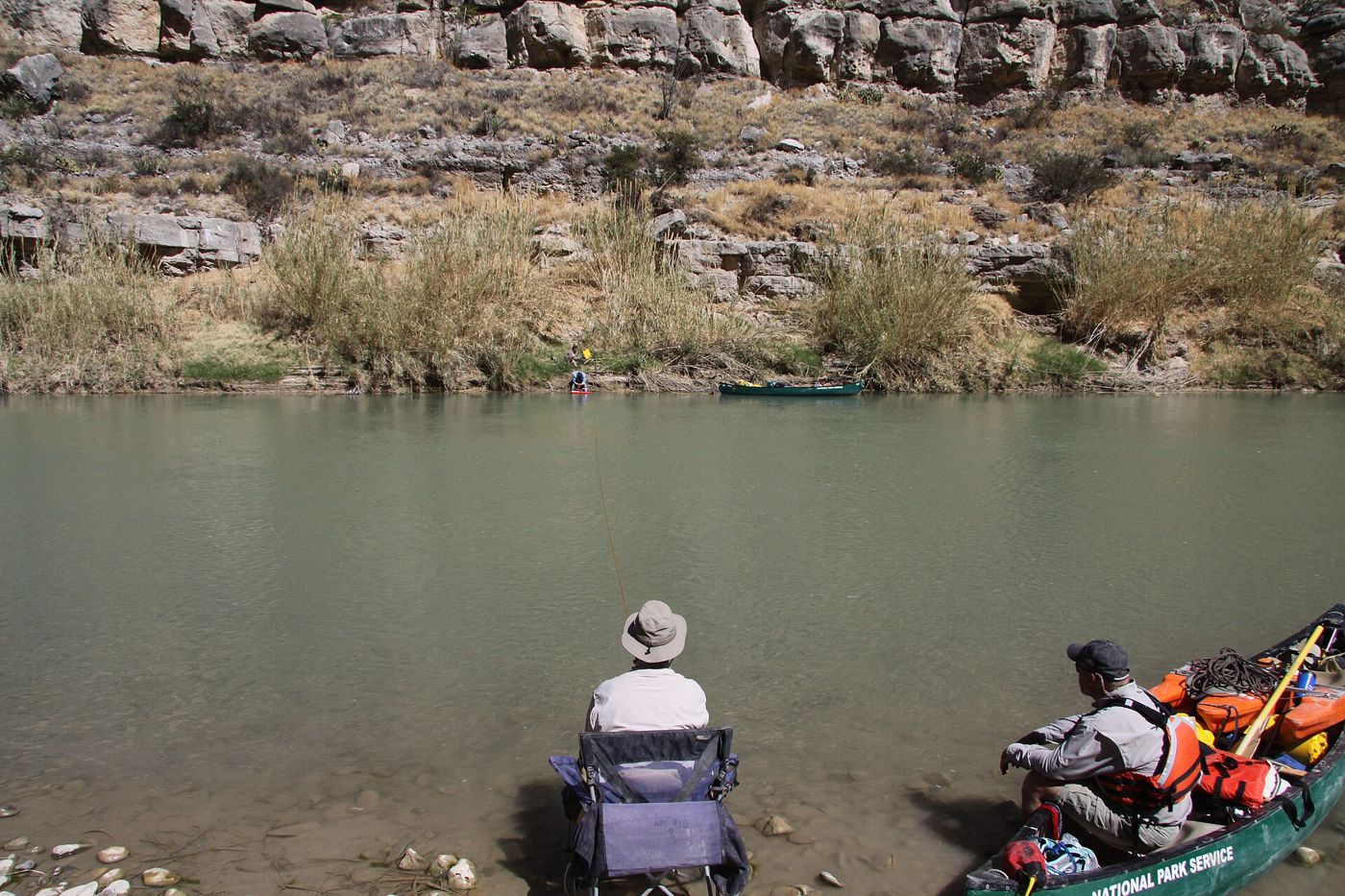
The Rio Grande in the Lower Canyons, Texas
6 · Chapter I · The desert east of Sanderson

Why does Moss go back?

NPS Photo, Public domain

Moss finds a drug deal gone wrong in the desert: dead men, a truck full of heroin, and one man still alive begging, “Agua.” Moss tells him he has no water and leaves with the money. That night he fills a gallon jug at the kitchen tap. “I’m fixin to go do somethin dumbern hell but I’m goin anyways.”

Christian reading

What does the story share with scripture and Christian practice?

The Good Samaritan stops for a stranger left half dead by the road. Matthew 25 counts giving water to the thirsty as giving it to Christ. Moss’s return is that act, and it is what starts everything: his truck is found, he is chased, and the killing that follows reaches his wife.

The book pays out its one act of mercy in disaster, which makes the Christian reading hard rather than comforting.

Opens a lot here

Where it falls short. Moss never says why he goes. The reading supplies a motive the text keeps silent about.

Luke 10:30–37; Matthew 25:35

Kantian aesthetics

Can beauty be enjoyed without wanting anything from it?

Kant separated acting from duty and acting from inclination. Nothing in Moss wants to go back. He knows it’s “dumbern hell,” and he goes anyway. That is close to Kant’s picture of a moral act: done against your own interest because it is owed.

It also mirrors Chigurh, who keeps his word against everyone’s interest. The book puts two men who follow through side by side, one for mercy and one for murder.

Opens a lot here

Where it falls short. Moss is also keeping two million dollars, which makes him hard to hold up as a model of duty.

Immanuel Kant, Groundwork of the Metaphysics of Morals (1785)

Trauma theory

How does a text carry an experience too large to be told straight?

Moss was in Vietnam. His father tells Bell late in the book that he was a sniper there. Trauma theory would read the dying man as someone Moss has seen before, in another country, and going back as a way of answering an old scene he couldn’t answer then.

Some light

Where it falls short. The book says almost nothing about Moss’s war, so the reading builds on very little.

Cathy Caruth, Unclaimed Experience (1996)

Marxist criticism

Who pays, who works, and how does the text hide it?

A class reading starts with the money: a welder living in a trailer finds more than he could earn in his life. That explains why he takes it. It has nothing to say about why he goes back with water, which risks the money and gets him nothing.

Little to work with

Where it falls short. The most important act in the chapter is the one it can’t explain.

Terry Eagleton, Marxism and Literary Criticism (1976)

Odessa, Texas
7 · Chapter IX · Carla Jean

Does Carla Jean have to die?

Jrs432, CC BY-SA 4.0

On the day she buries her grandmother, Carla Jean comes home to find Chigurh waiting in her house. He tells her, “I gave my word.” She says what everyone says to him: “You dont have to do this.” He offers her the coin. She refuses at first: “God would not want me to do that.” Then she calls heads, and the coin comes up tails.

Christian existentialism

Drawn from Douglas Ryan Favero’s essay in The Cormac McCarthy Journal 19.2, whose title takes her words.

How do people find the courage to exist in the face of death, meaninglessness and guilt?

Carla Jean tells Chigurh, “You’ve got no cause to hurt me,” and he agrees. So why kill her? Favero’s answer is that Chigurh has made himself the servant of the world, the one “in charge of who is coming and who is not.” His picture of himself depends on never acting from his own wishes and fears. If he spared her, he would have to judge himself a fool like everyone else.

Carla Jean turns his victims’ plea around. From her, “You dont have to do this” doesn’t mean “please don’t kill me.” It means you are fooling yourself if you think you have to. He kills her anyway, and three blocks later a car runs a stop sign into him. The essay reads his last scene, hurt, his gun left in the wreck, asking two boys for “any damn shirt,” as the end of his pose of invulnerability.

Opens a lot here

Where it falls short. It reads a great deal into Chigurh’s last few lines, which the book leaves bare.

Paul Tillich, The Courage to Be (1952); Douglas Ryan Favero, “‘You don’t have to do this’: Cormac McCarthy’s No Country for Old Men and the Courage to Be,” The Cormac McCarthy Journal 19.2 (2021)

Existentialism

Where does a person deny his own freedom so he won’t have to answer for it?

Chigurh says, “I got here the same way the coin did.” For Sartre, that is the textbook case of bad faith: a free person describing himself as a thing that can’t choose.

Carla Jean sees through it. “You make it like it was the coin. But you’re the one.” She is about to die, and she is the one who speaks for freedom.

Opens a lot here

Where it falls short. Favero’s essay disagrees: Chigurh isn’t dodging responsibility for her death. He believes he is fulfilling it, which is what makes him so hard to argue with.

Jean-Paul Sartre, Being and Nothingness (1943)

Feminist criticism

Whose voice, work and point of view does the text center, and whose does it use?

The women in the book are a wife, a dying grandmother, a young hitchhiker, and Bell’s wife Loretta, waiting at home. They mostly wait, worry and suffer what the men set off. Carla Jean dies for a promise two men made about her.

But she is also the clearest moral voice in the book. She refuses the game and names the lie, and Bell is still thinking about her chapters later. A feminist reading notices that the person who sees most is the one with the least power.

Opens a lot here

Where it falls short. The book gives women little space, so the reading mostly works from the margins.

bell hooks, Feminist Theory: From Margin to Center (1984)

Mimetic desire

Do we want things because someone close to us wants them?

René Girard argued that communities end violence by heaping it on an innocent scapegoat. Carla Jean has nothing to do with the money, and her death closes the account between Chigurh, Moss and the men in the office.

Some light

Where it falls short. No community gathers around her death or is restored by it, which is what Girard’s scapegoat needs.

René Girard, The Scapegoat (1982)

A windmill in Terrell County, Texas
8 · Chapter XIII · The last page

What does the last dream mean?

Carol M. Highsmith, Public domain

The book ends with Bell telling his second dream about his father. They are riding through a mountain pass at night in the snow, and his father rides past him carrying “fire in a horn the way people used to do.” Bell knew “he was fixin to make a fire somewhere out there in all that dark and all that cold and I knew that whenever I got there he would be there. And then I woke up.”

Psychoanalytic criticism

What does the text do with a wish or a loss it can’t face directly?

For Freud, dreams fulfill wishes in disguise. Bell has just said he thinks he became a better man than his father, “bad as that is to say,” and that he hasn’t thought about him as much as he should. In the dream the father rides ahead, says nothing, and makes a place for him. The son’s guilt is answered by a father who isn’t angry.

Opens a lot here

Where it falls short. It explains the comfort of the dream but turns the final image of the book into a private symptom.

Sigmund Freud, The Interpretation of Dreams (1899)

Christian reading

What does the story share with scripture and Christian practice?

A father who goes ahead to prepare a place, light carried into the dark: the dream is close to the Gospel of John, “I go to prepare a place for you,” and to the light that shines in the darkness. After a book with so little hope in it, the last image is of something kept alive and waiting.

Then Bell wakes up. The book offers the promise and takes away the certainty in the same breath.

Opens a lot here

Where it falls short. McCarthy keeps God offstage. The reading puts him on.

John 1:5; John 14:2

Intertextuality

What other books is this one talking to?

Julia Kristeva described every text as a mosaic of other texts. This one opens with Yeats and ends with an image McCarthy would make the center of his next novel, The Road (2006), where a father tells his son they are “carrying the fire.” Read together, the two books pass the fire from father to son.

Opens a lot here

Where it falls short. You need to have read The Road for it to work.

Julia Kristeva, “Word, Dialogue and Novel” (1966); Cormac McCarthy, The Road (2006)

Reader-response

What does the reader bring, and what does the text leave for the reader to fill in?

The last four words, “And then I woke up,” leave the reader where Bell is, back in the cold, deciding what the dream was worth. Iser would call it a gap. Some readers close it with hope, others with grief, and the book seems to want both.

Some light

Where it falls short. It describes the openness without helping you decide.

Wolfgang Iser, The Act of Reading (1976)